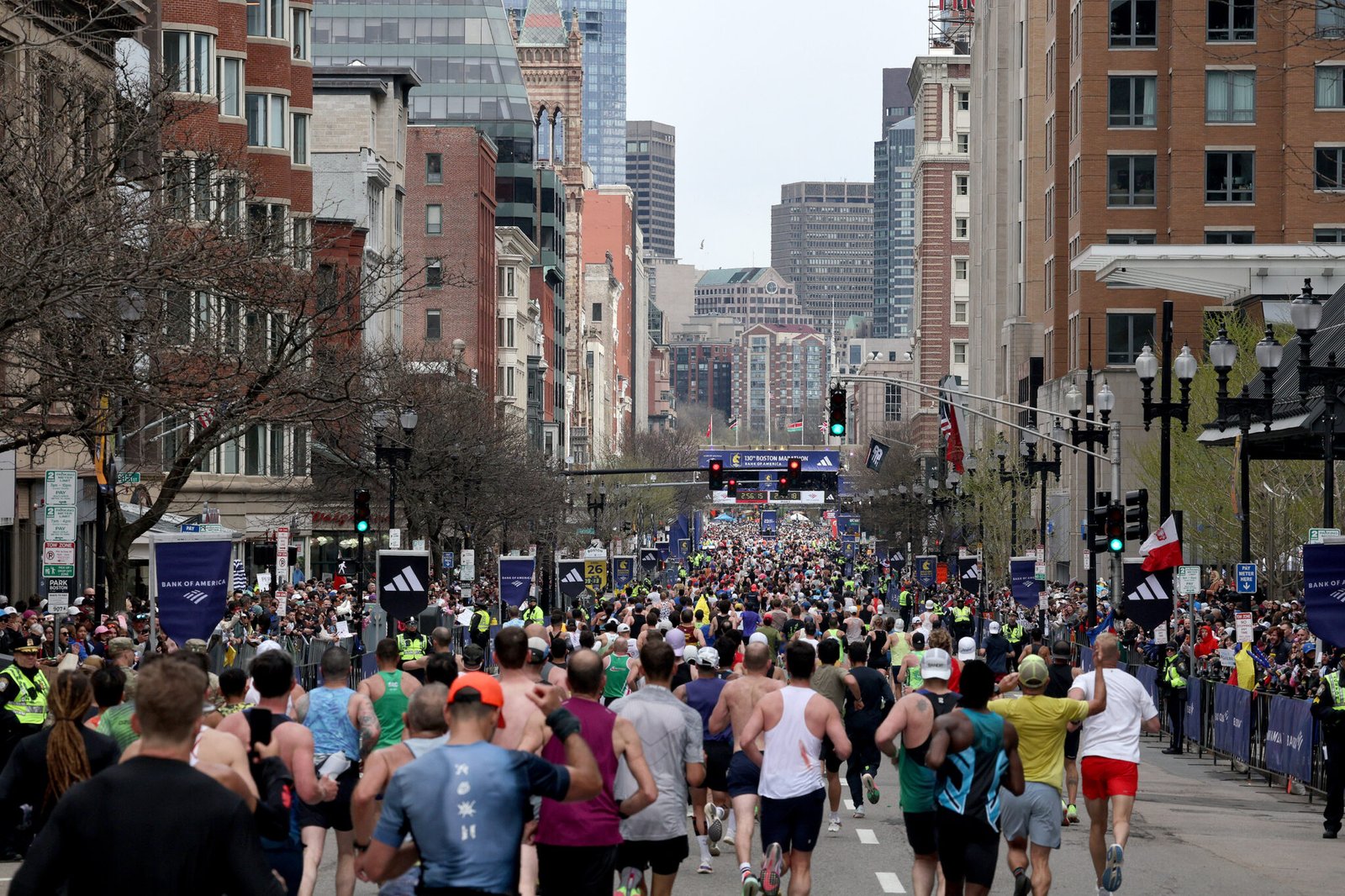
This week, the Boston Athletic Association made a big announcement about registration for the 2027 Boston Marathon: there would be a new lottery for runners who met their qualifying time but missed the cutoff time.
They also announced the dates for registration: September 14 to September 18. This means that the weekend of September 12-13 (including the Erie Marathon) will be in the registration period. This was always likely – but it’s good to know for sure. And if you were holding off on booking a last chance qualifier, now’s the time to do it.
But back to the lottery. BAA announced that they will hold a special drawing, called the Boston Qualifier Selection, to accept 1,000 runners into the 2027 Boston Marathon. Any runner who met their qualifying time but missed the cutoff would be eligible.
Sounds great, especially if you’re in the group of runners who likely won’t make the cutoff. Based on the current data, that’s likely to be in the ballpark of 5:30, so it’s a sizable group. But what are the odds of actually getting in this way?
Maybe better than you think. Keep reading for an analysis of the data – and how this could evolve over the next few years. The other question on everyone’s mind is, “Is this fair?” So I’ll wrap up with some opinion on that matter at the end.
What Are the Odds for the Boston Qualifier Selection?
The odds of being selected in this lottery will vary by two things: the number of available spots and the number of rejected applicants.
BAA was kind enough to make the first part clear. There are 1,000 available spots in this lottery.
The second number is variable. But we can use recent data to estimate this number. We know how many runners were rejected in each of the last few years.
Last year, 8,887 applicants were rejected. That would work out to an 11.3% chance in the lottery. The previous two years, the number of rejections was higher (11,000 to 12,000), and this would equate to a slightly smaller change (8-9%).
So assuming the trends from recent years hold, you can expect the odds to be approximately 8% to 12%. Those aren’t great odds. But they’re significantly higher than the lotteries for New York or London, and it’s the best chance you’ve got if you have a small buffer.
How Will This Change Moving Forward?
There is, of course, the possibility that current trends change moving forward. If the number of rejected applicants change, the odds would also change.
There are two big things that could change over the next few years and the first is goal setting. This year, there are more runners with medium buffers (5:00 to 10:00) and fewer with small buffers (less than 5:00). As people have become accustomed to large cutoffs, they’ve been targeting faster times – and I suspect some people that are on the edge (i.e. BQ-1:00 or BQ-2:00) either didn’t try or risked it all for a better time (and possibly failed).
If a small buffer gets you a chance to enter the lottery, the number of people with small buffers could begin to increase again. That won’t impact this year’s numbers. But it could increase the number of rejected applicants in the next few years.
The second thing is that this will definitely impact the choice to register or not. While some people will register for the Boston Marathon with a small buffer, many runners choose not to. The data bears this out.
Based on my sample of results, I can calculate an effective conversion rate for BQ’s – the percentage of applicants that will result from a given number of BQ’s. Note this isn’t the actual conversion rate, because I don’t track 100% of results.
In 2024, the effective conversion rate was roughly the same for runners with 0-5 minute buffers and runners with 5-10 minute buffers (~80%). This followed two years with no buffer, and many runners were taken by surprise by the 5:29 cutoff.
The next two years, the conversion rate for the moderate buffers (5:00 to 10:00) stayed about the same. But it dropped significantly for runners with smaller buffers. It was ~67% in 2025 and ~65% in 2026. The logical explanation is that many of these runners, especially those with one or two minute buffers, saw registration as futile and chose not to register.
Now, with registration earning you a place in a special lottery, that behavior will change. The effective conversion rate will almost definitely jump again for those people with 0 to 5 minute buffers. Without this effect, there would likely have been ~10,000 rejected applicants this year. Instead, it’ll probably be closer to 12,000 give or take.
That should put the odds of this year’s lottery back around 8-9% – with a trend towards slightly worse odds over the next five years if nothing else changes.
Will This Impact the Cutoff Time?
I saw some chatter on social media about whether this will have an impact on the cutoff time and the answer is – probably not.
It will definitely increase the number of registrants by changing the behavior of those runners with small buffers. And that will affect the math of how to model and project the cutoff time based on available data. But it won’t actually change the cutoff time itself.
The field of accepted applicants is filled up from fastest to slower runners. For a simplistic example, let’s assume that 24,000 runners had buffers of 5:00 or greater – and there are 24,000 spots available. The field is now full.
It doesn’t matter how many runners have buffers below five minutes. It could be 12,000, 24,000, or even 60,000. They will all be rejected just the same. This would have an impact on the odds in the lottery – but it would not change the cutoff time at all.
The other variable, however, is whether the number of accepted applicants changes. BAA’s announcement said that “The number of athletes accepted will be consistent with recent years.” But that doesn’t necessarily mean that things won’t change.
In recent years, the number of accepted applicants has varied from about 22,000 to 24,000. Last year was a high water mark (24,362). A small drop (i.e. 23,500 or 24,000) would still be consistent with recent years.
It’s also unlikely the overall field size will grow. The last two years saw about 32,000 total entries – the largest amount other than 2014 and 1996. Last year saw 29,000 finishers, more than any year since 2014.
So 1,000 lottery spots will have to come from a) charity and sponsor bibs, b) time qualifier bibs, or c) some combination of the two.
Worst case, those 1,000 spots come from time qualifiers. This would effectively nudge the cutoff time up about 30 seconds.
A more likely moderate case would be to reduce the number of time qualifiers by about 500 and take the rest from other categories. That would effectively nudge the cutoff time up by about 15 seconds.
So Is This a Good Thing?
Realistically, this will at least slightly increase the cutoff time. And even if it didn’t, and these are net new spots, the counter-factual would be: why don’t you just give these to the next fastest runners?
There’s going to be a runner that misses the cutoff time by a second – and they’ll be rejected so that this lottery can happen. If you’re that runner, you may well hate this idea. But I think it’s a good choice, and here’s why.
No one likes big cutoff times and they generate a lot of frustration among runners. So BAA has had to make choices to try and limit them.
Reducing the qualifying times helped. But some people assumed a five minute adjustment would eliminate the cutoff – and that clearly didn’t happen. And the further qualifying times drop, the more exclusive (elitist?) the race will become.
Penalizing downhill races helped a little bit. But the current downhill results index probably shaved ~30 seconds off the cutoff. There’s little room for further changes. Likewise, the elimination of the double dipping period was a small, one time adjustment.
The number of finishers across the world has continued to grow this year, as have the number of qualifiers. There’s no indication this will slow down. So absent additional changes the number of applicants will continue to grow.
Reducing the qualifying times further would lower the percentage of runners who qualify. The current qualifying times are still manageable for many runners who make a long term commitment to the sport. That’ll change if they drop another 5 to 10 minutes.
This lottery is a compromise that a) maintains the competitive nature of the event while b) keeping it accessible to a broad range of serious amateur runners. It also means that the qualifying time itself has a meaning – and there is a reward for targeting this time even if you’re not ready to run 6-7 minutes beneath it.
This is not a general lottery (which would attract hundreds of thousands of applicants). Runners still have to BQ. And the numbers work out so that there’s a meaningful chance of getting selected – and not just a token chance.
Maybe they’ll tweak the specifics moving forward. But the general concept – reserving a small number of bibs for runners who BQ but don’t make the cutoff – is a better choice than simply reducing the effective qualifying times year over year with no end in sight.
But that’s just my opinion. What do you think?
First time commenter, long time reader. I’ve been simultaneously using Claude to predict how safe my 6:44 buffer is. Ran your article through my chat – Claude agreed with the majority of your logic except one piece, which I think is interesting…
“Where I Disagree With Rock
He’s now directly contradicting the BAA’s own communications director. Lotsbom explicitly said the 1,000 bibs are “not taken from any other allocation.” Rock says they have to come from somewhere given the field cap. Fleming said “not going to see a dramatic increase in field size.”
Rock’s resolution — “the last two years saw about 32,000 total entries, the largest other than 2014 and 1996, with 29,000 finishers” — actually contains the answer he’s missing.
32,000 entries → 29,000 finishers = 3,000 DNS/DNF runners. That’s exactly where the 1,000 additional spots come from. The BAA doesn’t need to cut charity bibs or time qualifier bibs — they just need to reduce their DNS buffer allocation by 1,000, knowing the crowd science work makes their DNS modeling more precise.
Rock dismisses this possibility too quickly. His conclusion that the lottery “will at least slightly increase the cutoff time” by 15–30 seconds assumes the total time qualifier allocation shrinks — but that’s only true if the DNS buffer explanation is wrong.“
BAA said these bibs aren’t coming from other allocations – but I’m skeptical. It sounds to me like PR spin.
It’s all conjecture at this point, though, and we’ll know more in September after registration and in the spring when the entry list is posted. I’ll bet the number of accepted qualifiers is slightly lower than last year – and the total number of registrants in the entry list is less than 33,000.
But either way, the decision effectively increases the cutoff. If they can add 1,000 bibs, they could add them for qualifiers … Doing so would effectively lower the cutoff by about 30 seconds, which they’d be choosing not to do.
The question is just whether the cutoff is higher than the projection (qualifier bibs are reduced) or it’s higher than it otherwise could have been (new bibs are added for the lottery).
Not sure if you saw the BAA’s interview in Runners World but I thought it was interesting for how they plan to come up with the “new” bibs and it is something that has been in the works for awhile it seems. Also, a big thank you for all you do! Appreciate the insight and passion with all of this.
https://www.runnersworld.com/news/a73258337/boston-marathon-drawing-qualifiers/
I’m not a fan of this concept. I think it sets a bad precedent and is essentially opening Pandora’s box. Adding a lottery of any kind signals they are open to people getting picked out of hat. That goes against the entire ethos of the Boston Marathon. I also think the idea that they’re going to placate people with this and then somehow avoid lower qualifying times is nonsense. Pure fiction. Trends would have to make a dramatic about-face, by that I mean in participation numbers (the running boom) would have to tank asap and we aren’t seeing that! So this is going to spiral out of control over the next few years until we see someone get a spot who had a 1 second buffer versus someone who was 8 minutes under the standard. Does anyone actually think that’s a great and fair system? Because I sure as heck don’t.
Pick your lane and commit. This race is the pinnacle for amateur runners – or it was. Don’t water down that achievement by introducing a lottery. I hate that we’ve decided the concept of elite is a negative. Are people working their butts off to be the best they can or what? The back of the pack doesn’t train to be slower. It’s really an insult to anyone with goals or aspirations that we can’t want and strive to be elite. Yes that means a lot of people don’t make the cut, but I maintain that there should be some things that are a little out of reach. It’s ok and in fact I think it can be motivating. After all there’s no god given right to run Boston. Or the be in the Olympics. Or own a Ferrari (any number of examples)
I’m with KR on this one simply because I’m one of those guys on the bubble…I have a 5:44 cushion. If they’re going to have a lottery, could they at least give runners who missed the cutoff by just a second or two better odds of winning a lottery spot? I.e. If the cutoff is 5:45 and I don’t get in, give me more ping pong balls in the hopper like in the NBA draft lottery.
Agree with Dave. I’m sitting at a 5:34 buffer (my Boston ‘26 time) and have been watching the spreadsheet like a hawk. Seems a bit unfair for Boston to change the game after those of us who put the work in to achieve stronger buffers getting denied because they decided to add a lottery. It would’ve been more respected to announce that change for the following entry period.