Feature photo by Sgt. Chancellor Reynolds – Public Domain
The 2025 Marine Corps Marathon was the 50th anniversary of the event, and it was larger than ever. The women’s winner, Tessa Barrett, set a new course record. But after word got out that her time – 2:34:08 – wasn’t actually going to qualify her for the US Olympic Trials Marathon, rumors started to spread that there may have been issues with the course itself.
Runners are, understandably, a little paranoid about these issues. A mis-measured course can result in an invalid time. For some, it’s just a reminder that their time wasn’t “real.” For others, it means that they won’t be able to get into Boston. Results from last year’s Atlanta Marathon ended up being invalid due to a measurement issue, and some runners at last year’s Seattle Marathon ran the wrong distance due to confusing signage.
But here’s the good news: the course for the 2025 Marine Corps Marathon was properly measured and certified, and runners who notched a Boston qualifying time will not have an issue using their qualifying time to apply to Boston.
Why Were There Concerns About the Course?
Although the course for last year’s race was largely the same as in the past, there were some minor modifications made due to ongoing construction and other logistical issues.
One user on Reddit reported that they attempted to measure out the new course, and it came to 27 miles. This was followed by comments from people who ran the race, claiming that their watch measured long as well.
It’s not uncommon for the distance on your GPS watch to be longer than 26.2 miles. There’s always a certain margin of error with fitness trackers, and the GPS signal will never be 100% reliable. Combine that with the fact that runners don’t (and can’t, in a big race like this) follow a perfect tangent line, and you’re pretty much guaranteed to end up running a little long.
But it’s enough to plant a seed of doubt. This doubt was then fueled by a second fact: Tessa Barrett ran an Olympic qualifying time, but that time wasn’t valid for her to actually qualify for the 2028 Olympic Trials Marathon. At least one Reddit user connected the dots and assumed that this could be a sign of a course issue – and it could have potential implications for Boston aspirants.
I also had a reader reach out to me directly after this week’s newsletter went out. They had heard the same rumor, and they pointed out over 1,000 BQs were on the line.
It seemed like something worth chasing down, so I reached out to both USATF and the Marine Corps Marathon for some additional context.
Why Wasn’t Tessa Barrett’s OTQ Valid?
First, let’s deal with the misunderstanding about Tessa Barrett. Her time from the Marine Corps Marathon was invalid, as was reported in the Runner’s Gazette and mentioned in Fast Women. But it wasn’t because of a course measurement issue.
I reached out to USATF, and Jay Holder explained that the issue here was one of sanctioning. This was mentioned in the Runner’s Gazette article, but it’s easy to miss the distinction.
Event organizers can apply to USATF to become an officially sanctioned event. It’s up to the race organizers to decide to do so, and by doing so they agree to enforce certain rules and regulations. It’s also a requirement for a time to be eligible to qualify for the Olympic trials and to be eligible for a national record.
According to Jay, the Marine Corps Marathon has not been a USATF-sanctioned event since 2015, and this made Barrett’s time ineligible for qualification. They immediately notified her, although the issue is now moot because she ran another (faster) qualifying time at CIM in December.
The qualifying standards for the Boston Marathon, on the other hand, do not require an event to be sanctioned by USATF or an equivalent body. They only require that the course be measured and certified by USATF or an equivalent body.
Was the Course Properly Measured and Certified?
So the OTQ issue does not have any implications for qualifying for Boston. The two events have slightly different sets of rules for what times are eligible.
But there’s still the open question of whether the new course was actually properly measured and certified.
If you look in the USATF Course Database, you’ll find two active entries for the Marine Corps Marathon. One was certified last year for the 2024 race, and the other has been on file for several years. There is no new entry for the 2025 race.
Given the fact that the 2025 course did differ in some minor ways from the previous races, this would raise some eyebrows.
I reached out to the organizers of the race last night, and they immediately got back to me with a copy of the course map and information about its certification.
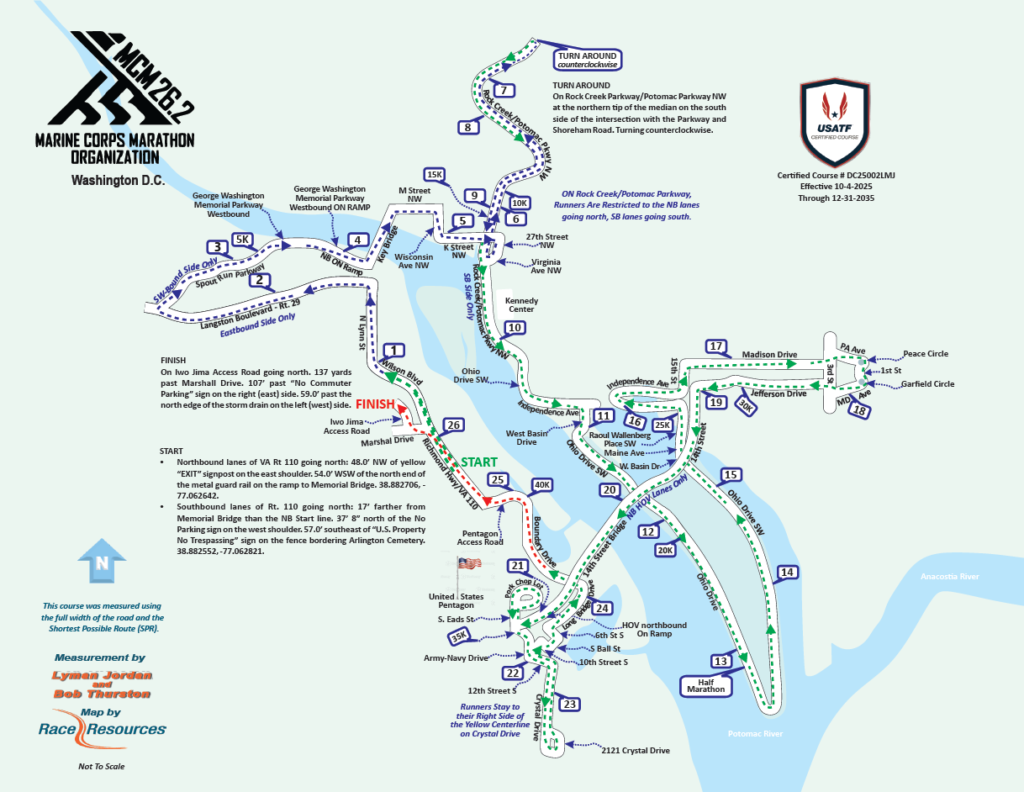
The new course was measured and certified on October 4, 2025. This was approximately three weeks before the race (October 26, 2025). The course bears a new ID (#DC25002LMJ) to distinguish it from the existing courses.
The race director, Alex Hetherington, said that they would be putting this information on the event website to help eliminate any confusion.
Can You Use a Result from MCM to Qualify for Boston?
So in the end, it seems like this was all just a little misunderstanding which fired up the rumor mill. No, Tessa Barrett’s time is not eligible for an OTQ. But yes, your time from the 2025 Marine Corps Marathon will be eligible for Boston qualification.
Although the race is not sanctioned by USATF, the course was properly measured and certified. It meets all the requirements that BAA sets forth for qualification for Boston, and you should have nothing to worry about.
After last year’s fiasco in Atlanta, it’s nice to have a happy ending to a story like this.
DC25002LMJ
When I search this I don’t get a result
https://certifiedroadraces.com/search/
It wasn’t listed in the database previously. However, I checked again and it is now listed – but with VA instead of DC as the prefix (VA25002LMJ).