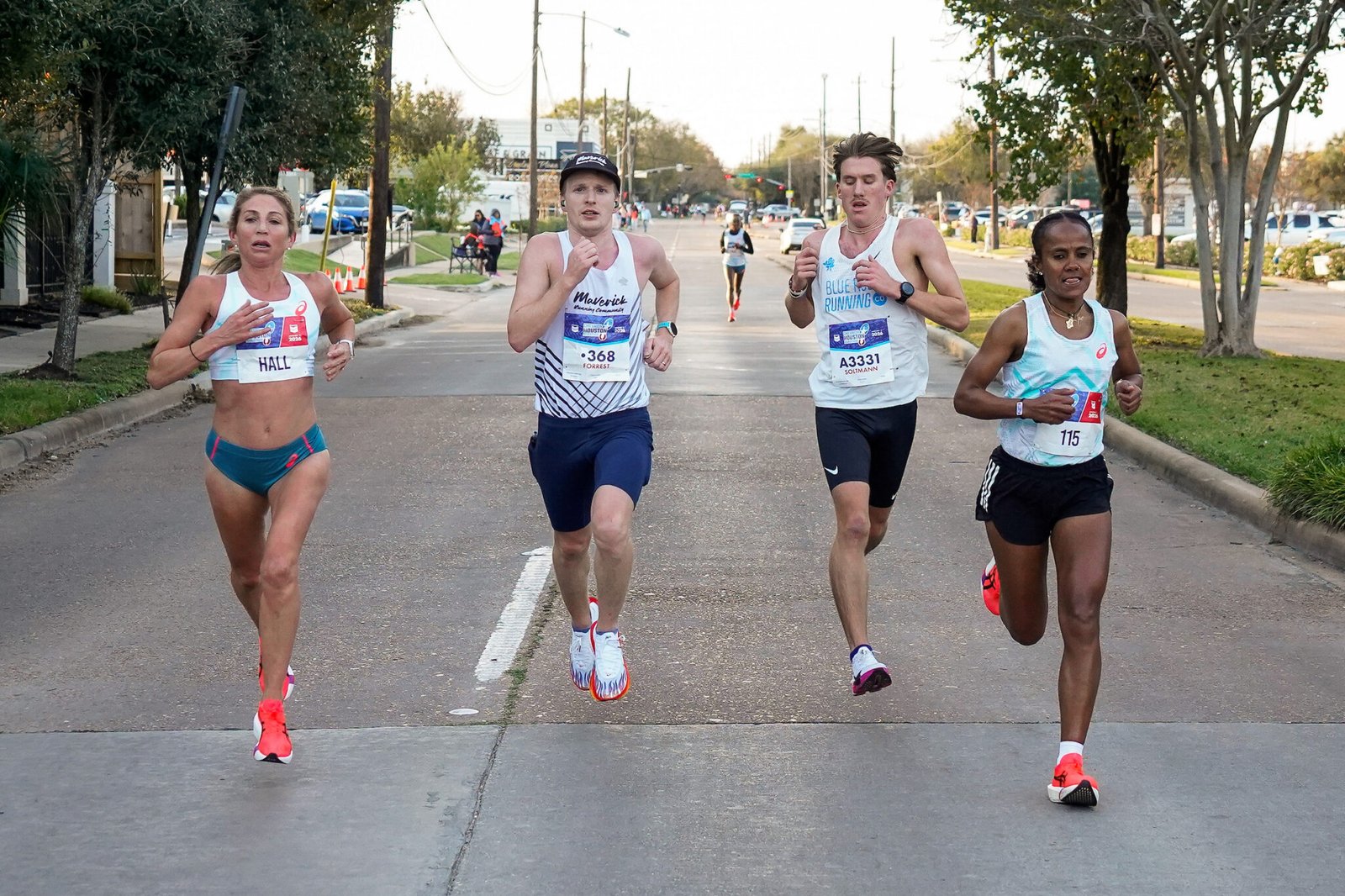
Feature photo (c) Kevin Morris – Courtesy of Houston Marathon
Last weekend was the 2026 Houston Marathon – a premier event that kicks off the new year in American marathoning. After a lull over the holidays, this usually marks the first large, fast event of the year – with a considerable numbers of BQs, a handful of OTQs, and the occasional record.
This year’s race didn’t disappoint. There were some fast times, and the field was much larger than last year. It wasn’t quite as explosive as 2025, when Conner Mantz and Weini Kelati set new American records for the half marathon. But it was close.
Last year, I did a deep dive on the history of the race and analyzed the data going back to when it started in the 1970’s. Refer back to that for some more historical context. But today’s deep dive will focus on how the race has changed in the last few years – and specifically how this year’s race was bigger, better, and different.
How Big Is the Houston Marathon?
Like many races, Houston started as a small race back in the 1970’s. It grew quickly over the next few decades, but by around 2010 it had reached a fairly steady point – with around 6,000 to 7,000 finishers in any given year. Last year it was the tenth largest race in the United States.
Pre-COVID, the peak year was 2016 – with about 7,800 finishers. After a dip in the years following COVID, the race came close to this level in the last two years.
But this year saw significantly more finishers than any other year. There were 8,852 finishers – 1,000 more than the previous largest year and a 17% increase year over year from 2025. That could push Houston ahead of CIM to be the #9 race in the country this year.
This year, the field was 65% men and 35% women. This is consistent with the last few years, but more male-dominant than it was a decade ago. This is also consistent with the larger national trend – where the number of younger runners is on the rise, but growth is stronger among men than among women.
Is the Age Distribution Changing?
The current running boom is being driven in large part by younger runners in their 20’s and 30’s entering the sport. With such a large year over year increase in finishers, is Houston also seeing a shift in the age distribution of its runners?
For most of the last decade, the number of runners under 40 was pretty consistent – around 2,000 men and 1,500 women. The last two years, that number increased, despite the overall field not growing.
This year it grew even farther. Well over 60% of the field was under 40. In the past, that number has typically been less than 50%.
When you break it out by age group, the largest cluster is men 25-39. There are about 1,000 men each in the 25-29, 30-34, and 35-39 age groups – up from about 800. But many of the age groups grew year over year.
Across the board, the number of finishers increased by about 17%. That’s marked by a dotted line on the visual above.
The youngest age groups all grew by larger rates than average. The 40’s were slightly below average and 50’s were even further below.
The one odd outlier is women 35-39 – which for some reason was about the same size as last year. The oldest age group (65-69) also grew by a larger percent, but there are very small groups to begin with.
How Fast Were the Runners at the Houston Marathon?
Houston is a fast race, and it’s known for fast times.
On average, about 10% of young men finish a marathon in under three hours. In Houston this year, 13.5% of the men under 40 went sub-3:00. That’s consistent with the last two years.
A similar, although not exactly equivalent, benchmark for women is a 3:30 marathon. Across all young runners, about 12% of women finish sub-3:30. At Houston, that was 18%. Again, that’s pretty consistent with the results from the past two years.
If you’ve been worried about the cutoff time for the 2027 Boston Marathon, then the results from this race are important. With such a fast field and a large increase in finishers, there are bound to be more qualifiers this year.
It’s relatively tougher for younger runners to meet their BQ’s than for older runners. So the concentrated growth among the younger age groups suggests that the increase in BQs may be slightly lower than the increase in finishers.
The overall increase in BQ’s was slightly lower than finishers, but not by much – about 16% compared to 17%.
Although the share of younger runners qualifying was lower than older runners, the runners at Houston fared much better than your average runner. Among men, about 10% of men in the 25-29 age group qualified – and the number of qualifiers from that group jumped from 82 to 123. Women did even better, with 14% of the 25-29 age group qualifying. The average numbers across the United States are much lower.
All told, this race produced an extra 165 qualifiers over last year. The total year to date number of qualifiers is still down slightly from last year, due to how the beginning of the qualifying period started. But this represents another week in which the number of qualifiers continues to rise – and it will likely do so through September.
What About the Fastest Runners?
Last year, Conner Mantz and Weini Kelati set new American records in the half marathon at Houston. This is also the race where Ryan Hall set his longstanding American record in the half marathon (2007). And it’s where Keira D’Amato set an American record in the marathon (2022).
Among Americans, Zouhair Talbi made the biggest splash. He won the marathon in 2:05:45, which is a new course record for Houston. It’s also the #3 all time marathon for an American man – behind Conner Mantz’s new record from Chicago and Khalid Khannouchi’s longtime record from London. Sara Hall finished in a strong second place in the women’s race (2:26:26).
In the half marathon, Habtom Samuel set a new course record (59:01). The previous course record was established last year by Conner Mantz (59:17). Alex Maier finished as the top American in the race (59:23) – just six seconds off the American record that Mantz set last year. On the women’s side, Taylor Roe was the top American (1:06:20), and she was just 11 seconds off the record set last year by Kelati.
Seven American men and eleven American women met the standard to qualify for the 2028 Olympic Team Trials. Another three men came up just short, finishing ahead of the old standard (2:18) and below the new one (2:16).
That brings the total number of runners who have already qualified for the trials to over 200 – 100 men and 107 women.
What’d You Think About the 2026 Houston Marathon?
This race is on my bucket list, and one of these days I’ll make it out there. Like many other races, it’s been selling out earlier and earlier – with this year’s race reaching capacity on October 1, 2025. If you plan to run in 2026, you’ve got plenty of time … but it would still be worth locking things in sooner than later.
What did you think of the 2026 Houston Marathon? Did you run it this year – or have you run it in the past?
It was the third time I have run the Houston Marathon. There was perfect weather, fabulous crowds and I had the best marathon time per age ever!! I had my 4th BQ (45 overall marathons) and have a 23 minute cushion (largest in previous BQ was 8 minutes). It was a great experience.
Ran Houston a 2:56 with a 19 minute cushion (M 45-49) and my 3rd BQ in a row. The weather was perfect and I PR’ed by 12 minutes. To say I was satisfied with the result would be an understatement.