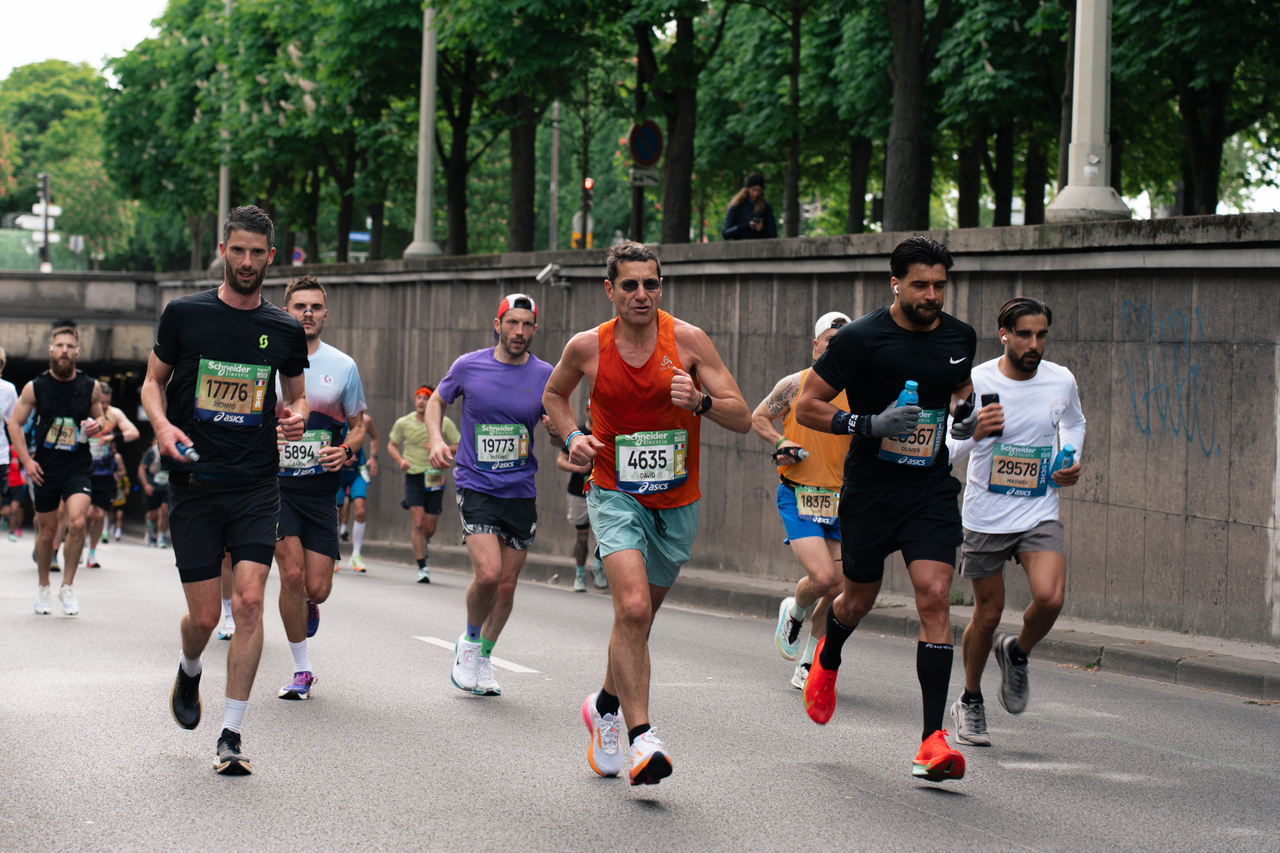
Feature image by David Lisnard on Wikimedia Commons – CC BY SA-4.0

When I started collecting and analyzing data on marathons a couple years ago, Paris was not on my radar at all. I mostly paid attention to American races, along with the international races that were part of the Majors.
But Paris is a huge race, and it regularly ranks as one of the largest races in the world in any given year. So while it may not be one of the Majors, it’s still an interesting topic to dig into.
This year, there was an extra reason to be curious. For environmental reasons, Paris changed up its aid stations and stopped using disposable cups. A reader reached out to me curious to see if this had any impact on finish times – and that’s part of why I decided to focus on Paris this week.
So I collected the results from the 2025 and 2026 Paris Marathons, and we’ll explore a few questions using that data.
- How big was the race – compared to other large marathons?
- What’s the gender breakdown, did it change, and how does it compare to the Majors?
- What’s the age breakdown, did it change, and how does it compare to the Majors?
- Where are the runners from? Is it more or less international than the Majors?
- How fast is the field?
- Is there evidence that the water change slowed people down?
Let’s get to it.
How Big Is the Paris Marathon?
Paris isn’t one of the Abbott World Marathon Majors and if you’re in the United States it might not be on your radar as a “big” race. But it’s one of the biggest marathons in the world.
In fact it was, briefly, the biggest marathon in the world. The visual below summarizes the size of the five largest marathons in the world going back through 2019.
Before COVID, New York held the record with over 53,000 finishers in 2019. Paris was the second largest race that year, but it was still well short of 50,000 finishers. In 2022, it lagged behind the others in the rebound from COVID. But that changed in 2023.
That year, Paris broke the 50,000 mark for the first time. London and Chicago were still just under 50k. New York would have slightly more finishers come November, but it still didn’t breach the 2019 peak.
Then, in 2024, Paris pushed the bar higher. At the beginning of April, it had 53,899 finishers. It was slightly larger than the 2019 New York race, and it was just large enough to remain above a record-high number of finishers at London later in the month. Paris held the record for the world’s largest race until September, when Berlin came along with an astounding 54,000+ finishers.
Since then, London and New York have been locked in a struggle for the world’s largest race. Two years in a row, Paris has had slightly fewer finishers than London. But this year’s total – 57,516 – was an almost 5% increase over last year.
What’s the Gender Distribution of Finishers at the Paris Marathon?
The media kit for the Paris Marathon contains a page titled, “Celebrating Women.” It notes that the race has a record number of female registrants (~20,700). It also begins with an anecdote about how Kathrine Switzer was the “first woman to take part in a marathon wearing an official bib.”
That’s not exactly true. She was the first to run Boston with an official bib. But Arline Piper (Stine) ran Pikes Peak in 1959 and Merry Lepper finished the Culver City Marathon in 1963. Switzer was one of a handful of women breaking boundaries and changing the narrative throughout that decade.
But I digress.
This year’s race did see more female finishers than last year. The number of actual finishers (18,261) was significantly fewer than the advertised number of “starters” (which is really actually registrants), but it was an almost 12% bump over last year’s figures.
Still, the share of female participants within the field was only about 32%. This may have been a record high for Paris, but it’s low relative to other large marathons.
This compares the gender distribution of the Majors. I left out Boston because I wanted a nice grid with six charts – but it would have looked similar to London. The data is from the most recent edition of each race – either spring 2026 or fall 2025.
The top row – the other three races that consistently exceed 50,000 finishers – have fields where between 43% and 46% of finishers are women. Each of them is well above 20,000. Even Berlin, which historically has a male-heavy field, has a higher percentage of women.
The only major race with relatively fewer women than Paris is Tokyo. Just over a quarter of the field at Tokyo is made up of women.
The gender distribution at Paris may be relatively equal compared to other European races – many of which are tilted much more heavily towards men. But when you compare it against the other massive international races, the share of women in the field is conspicuously low.
What’s the Age Distribution of Finishers at the Paris Marathon?
How about the age of the finishers. What does that look like, has it changed since last year, and how does it compare to other major races?
The Paris Marathon doesn’t report a runner’s actual age. It just reports their category. There’s a relatively broad Senior category (23-34) followed by 5 year age groups after that.
The visual below shows the number of finishers in each age group last year (the bar) compared to the number of finishers in that age group this year (the dot). If the dot is higher than the top of the bar, that age group increased in size.
In terms of relative size, the Senior category (23-34) is by far the largest. That age group includes about 15,000 men (just under 40%) and 8,000 women (just under 50%).
As you move to the right, the age groups get progressively smaller. The first Masters age group (35-39) is about one third of the size of the larger men’s group and one quarter the size of the larger women’s group.
Among men, the last age group with over 1,000 finishers is 60-64. For women, it’s 50-54. There are still a fair number of men in their 60’s, but exceedingly few women. There are even fewer finishers in the 70+ age groups, so I excluded them to make the graph more readable.
In terms of year over year difference, most age groups grew at least slightly. The two biggest outliers look to be the men’s senior category – which actually shrank – and the women’s senior category – which grew by a larger amount.
This version of the graph shows the same data, but it portrays each age group as a percent of it’s respective gender.
Presented this way, the men’s senior category did shrink – but not by a ton. Most of the masters categories increased in relative size by a tiny bit.
On the women’s side, the women’s senior category actually shrank, too – as a share of all women. Despite the fact that the actual number increased by ~700, the other age groups (45-59, especially) grew faster.
This version of the graph also makes it more clear how women in general are tilted towards younger runners – with nearly 50% of women in the senior category and smaller percentages in their 50’s and 60’s.
How does this compare with other large races? The visual below summarizes that. The dropdown filter lets you toggle between men and women.
Note that this is absolute numbers – not percents. Tokyo is much smaller than the other five. But it’s still striking how the age distribution at Tokyo is so different – with almost as many men in the 50-54 age group as in the 23-34 age group.
Another quirk of the data is that London lumps all younger runners into the 18-39 age group. So at first glance, it appears like it’s the race with the largest number of young men. But if you were to add that age group with the 35-39 age group, it’s similar in size to New York.
And Paris would, by far, be the largest. Among men, the three youngest categories (20-22, 23-34, and 35-39) total 22,233 – compared to 16,730 at London and 15,683 at New York.
Among women, though, New York has the most young runners – 16,055 across the three youngest age groups. That compares to 15,111 for Chicago, 14,734 for London, and a paltry 11,423 for Paris.
This is in part a reflection of the gender distribution – Paris has far fewer women overall than these other races despite being the same size.
The ratio of young women (18-39) to women 40-44 is highest at New York. But it’s higher at Paris than it is at London or Chicago. That same ratio is highest at Paris for the men.
Where Are the Finishers From?
Aside from age and gender, another interesting question about the finishers is where they are from. As these big races have grown, they tend to attract more international audiences.
The visual below shows how many finishers came from the top ten countries in 2025 and 2026.
Overall, the distribution of domestic and international runners has stayed about the same. The number of French finishers increased from 2025 to 2026, but the share of the overall field remained about the same. In each year, just over 70% of finishers were from France.
When you dig into the top 10, there were some minor variations. The share of British runners dropped slightly (8.9% -> 8.1%) and the share of American runners increased slightly (2.6% -> 3.2%). Otherwise, the distribution of finishers remained about the same.
If over 70% of finishers come from the host country, how does this compare to other large races?
The visual below shows the share of runners who are local (from the host country), American, or international (from any other country besides the United States or the host country). Note that for Chicago and New York, the American share is displayed under the “Local” label.
Of these six races, Paris has the largest share of runners coming from the host country – with London and New York a few percentage points behind. Boston, which isn’t pictured, would look similar to New York.
Berlin is at the complete opposite of the spectrum. It still surprises me that such a small share of finishers at Berlin are from Germany.
Of the four races outside the United States, Paris also has the smallest share of American runners. Only 3% of finisher are from the United States. There are much larger American contingents at London, Berlin, and Tokyo. Other large international races, like Valencia, also have very small cohorts of American runners.
One potential explanation for this is that American runners are strongly motivated to travel for the Majors – but otherwise they prefer to run a local race or travel within the United States. Other large American races also have relatively few international runners compared to New York, Chicago, and Boston.
How Fast Is the Field of Finishers?
I’ve always assumed that Paris was not a particularly fast race. But what does the data say?
According to the press kit, the average finish time is 4:10 – which is “the fastest marathon among those with more than 40,000 finishers.” When I read this, I was skeptical.
But it turns out it’s true – at least true enough, depending on how you define your methodology.
The overall mean finish time for the 2026 Paris Marathon was 4:13:22. Compared to the most recent edition of London, New York, Chicago, and Berlin, the next fastest race was Chicago (4:21:47). The median finish times are faster, but Paris is still the fastest (4:08:46) followed by Chicago (4:12:52).
Of course, we established above that Paris leans more heavily male than any of these other races. Since men tend to be faster than women, that could skew the results. If you break the data out by gender, the men at Paris still have the fastest mean finish time (4:04:41) followed by Chicago (4:06:36). The women at Paris, however, come in second (4:32:04) after New York (4:28:24).
However, when you disaggregate the data by gender, there’s a significant difference between mean and median. The median finish time for men is faster at Chicago (3:55:47) followed by Paris (3:59:11). When you measure speed by the median, the Paris woman are the fastest (4:27:27), followed by Chicago (4:32:48) and then New York.
Finally, the age distribution of Paris also skewed younger than most of these other races. That could also skew the overall averages. If you narrow things down to just runners under 40, then the mean time for men at Paris is just a hair behind Chicago. The Paris women have the fastest mean time. The same is true of the median, although the men’s median at Chicago is further ahead of Paris.
So apparently, the field at Paris is faster than other massive races – at least by average finish time.
But that also doesn’t mean that the field is fast. It’s also possible that the distribution is tighter and there are fewer slow runners to pull up the average.
To compare the front of the field, I counted up the number of finishers under 40 who met certain benchmark times – 2:45, 3:00, and 3:30 for men; 3:10, 3:25, and 4:00 for women. Again, the data comes from the most recent edition of each race.
When you look at it this way, Paris had the fewest number of runners hitting the two fastest benchmarks (2:45 and 3:00 for men; 3:10 and 3:25 for women). At the third benchmark, Paris pulls ahead of Berlin but still lags behind the others.
The fastest end of the field may be influenced by the fact that the other four races have qualifying times that allow very fast runners to gain entry into the race. But Paris is not a lottery system, and many “fast” races in the United States have 10% or more of their young finishers break 3:00 (men) or 3:25 (women). Here, the rate for Chicago is about 14%, for Berlin and London it’s around 10%, and for Paris it’s less than 6.5%.
So I think it’s fair to say that Paris has a faster average time than other large races – but it doesn’t have a particularly fast field.
Did the Cupless Water Stations Slow People Down?
Finally, we’ll get to the question that actually made me dig into the Paris Marathon data. Did the changes to the aid stations make a difference?
In case you weren’t paying attention to this, Paris announced that it would be eliminating disposable cups. Instead, they set up hydration stations where you could fill up a reusable cup or a handheld bottle.
Note that there was a separate set up for runners targeting 2:50 or faster. These runners could grab a prefilled bottle and drop it in a bin 150 meters after the aid station. And as we saw above, this was a relatively small group of people at the front of the field.
For everyone else, this sounds crazy at first. If you’re trying to run a personal best, do you want to slow down and/or stop at each water station? I saw an Instagram reel of a guy running 4:20/km (~7:00/mi), and he tried to run through each aid station without slowing down. The result was that he often didn’t get his cup filled up, even though the volunteers tried their best to shoot into the moving target.
But I also watched a couple videos of people cruising into an aid station, slowing down briefly, and taking off again a few seconds later. Even if you stop 8-10 times throughout the race, that’s probably not more than 1-2 minutes. And if you were smart enough to bring a handheld – which would have been my approach – you probably could have cut that down to 3-4 stops throughout the race.
In any case, is there evidence in the finish times that the changes to the water stations slowed people down this year?
Below is a visual that shows the distribution of finish times between 2:30 and 4:00. The dropdown toggles between men and women. The data is only for runners under 40. If the aid stations were particularly problematic, you’d expect to see the distribution shifted to the right.
What you find instead is that runners were slightly faster this year – at least at the faster end of things. From about 2:55 to 3:05, the 2026 line is higher than the 2025 line. The women’s line, too, shows faster times (at least marginally) this year than last year.
However, there is a period from ~3:30 to 4:00 where men performed better last year. The further back you go, the less impact the aid stations should have. So it may be unrelated. But it’s hard to say for sure.
There’s also the fact that the weather was slightly better this year than last year. It’s a confounding factor – and it’s possible that this explains the faster times. Or that the times would have been faster without the aid station change.
It’s an interesting experiment, and I wonder whether it will catch on with other races. I was initially skeptical about how it would work, but after watching some videos I don’t know that it’s a terrible idea. I carry a handheld on my long runs anyway, so I’d likely bring that same handheld along if I had to refill it during a race.
Based on this data, it’s hard to say for certain whether or not it had an impact on finish times. But I think it’s fair to say that it didn’t have a catastrophic impact – although it’s very possible that it cost some runners a marginal amount of time.
The Bottom Line on the Paris Marathon
So there you have it. That’s the story of the Paris Marathon told through the data.
The race is one of the largest in the world, but it’s no longer in the running to be the largest. The race has shifted to include more women in recent years, but it remains more heavily tilted towards men than the Majors. The demographics of the runners also skew very young compared to the Majors.
Despite being a massive race, the international appeal of the race is low. The vast majority of runners come from France, and the majority of the international runners come from Europe. Berlin – another European race – sees many more international and American runners than does Paris.
Although the race isn’t particularly fast when you look at the fastest runners, it is relatively fast on an average basis. The average finish time, even when you disaggregate by age and gender, is either fastest or second fastest when compared to Chicago, New York, Berlin, and London. But when you look at how many runners ran particularly fast times, like sub-3:00, Paris ranks towards the bottom of those races.
Finally, the cupless aid stations seem to have worked out well enough. It’s hard to pinpoint exactly what impact this change might have had on finish times, but there’s no big shift in the distribution of times from 2025 to 2026. It’s likely that this had a mild impact on some runners – but there’s no evidence that it caused runners to be significantly slower this year than compared to last year.
Did you run the Paris Marathon this year? Or have thoughts about the aid station situation? Leave a comment below and let me know.
Oh my – I didn’t expect you to zero in on this so quickly, and I got so much more than what I asked for. THANK YOU BRIAN!!!
No prob! Thanks for the inspiration. It’s kind of been in the back of my mind to dig into Paris for a while – and this was the little nudge I needed.
I wonder about another variable: I suspect that there are more runners using supershoes in 2026 than in 2025, but probably no way to get data on that, but if true it could be masking some deleterious effect of water stations on finish times, no?
I doubt it would have any meaningful impact year over year. If you rewind all the way to 2018-19, then super shoe adoption was much lower and there’s a noticeable shift in finish times when races returned after COVID. But at this point, I think it’s more or less baked in.