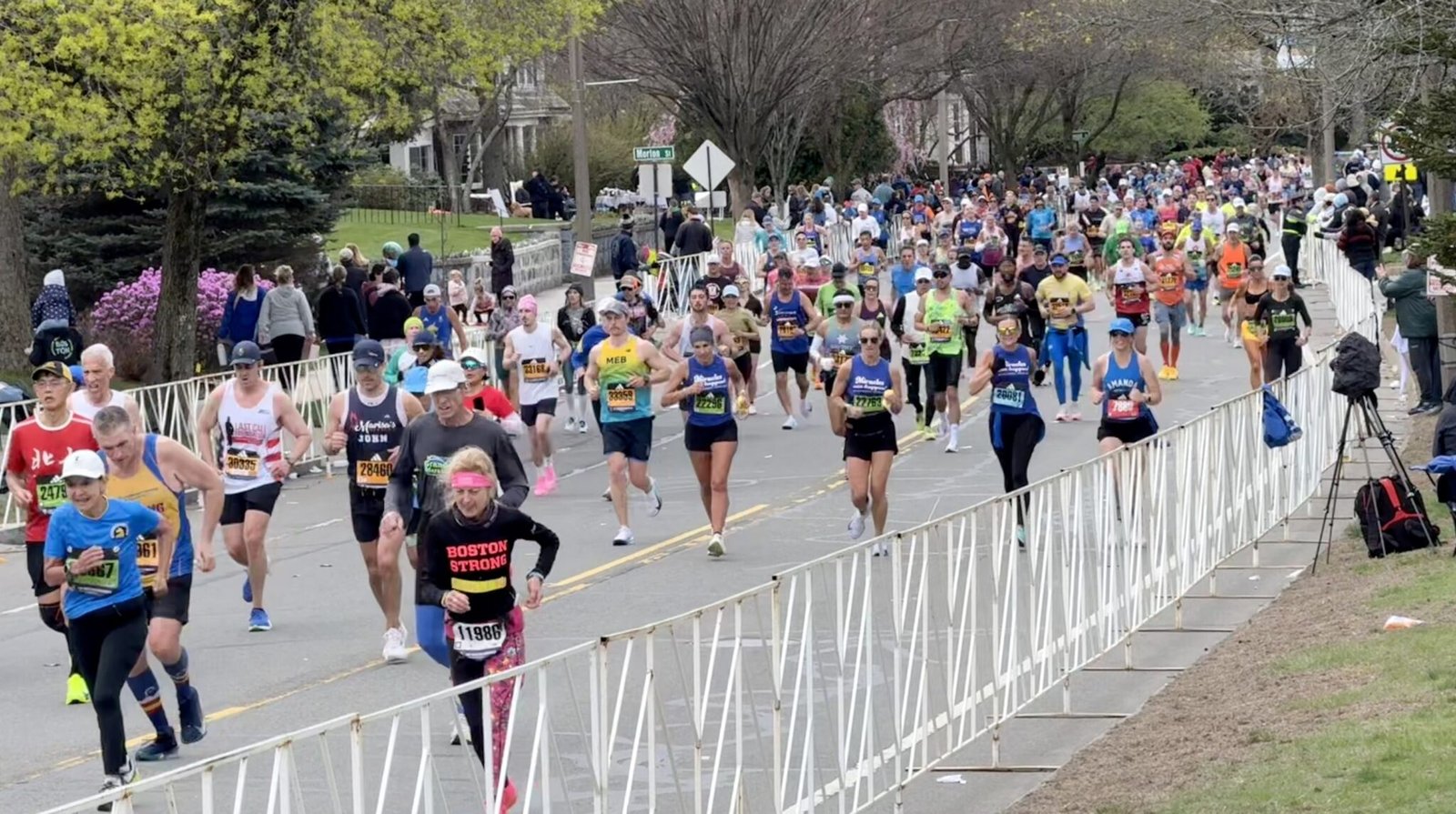
Feature Photo by ArnoldReinhold, CC BY 4.0, via Wikimedia Commons

It’s that time of year. Unless you’re training for the 2027 Boston Marathon, you’re looking ahead to the 2028 Boston Marathon.
Next year’s race saw the toughest effective qualifying times in the history of the Boston Marathon. An open division runner needed to run 2:49:43 (Men) or 3:19:43 (Women) to make the 5:17 cutoff. The last time the qualifying times were 2:50 / 3:20 was back in 1986.
Will things get harder from here? Hate to be the bearer of bad news, but they probably will.
It’s too early to make any firm predictions about the outcome. But the last two months have seen a significant number of races run in the qualifying period for the 2028 Boston Marathon. I spent the last two weeks collecting that data and I’m now ready to launch the 2028 Boston Marathon Cutoff Time Tracker.
So what does the data say about whether the cutoff will be higher this year? As the Magic 8-Ball would say, “signs point to yes.”
How Accurate Was the Tracker In the Past?
For the uninitiated, let’s start with a quick explanation of how the tracker works and how accurate it has been in the past. You can find a more detailed explanation of the methodology at the bottom of the page hosting the tracker, but here’s the short version.
The cutoff time is driven by how many more qualified applicants there are than available bibs. Based on data from the past decade, there is a pretty strong correlation between the rejection rate and the eventual cutoff time.
Until we know how many people actually apply, we need to guesstimate that number. And the biggest indicator of that is how the number of qualifiers across all qualifying races goes up or down. That’s where the tracker comes in. I track a sample of ~250 races across the United States and Canada to see which way the wind is blowing.
If the number of qualifiers is up 5%, we can assume the number of applicants will also be up 5%. Then, we can plug that number into the regression equation based on the past data and get a predicted cutoff time.
Since 2015, 11 Boston Marathons have required a cutoff time. If you take the data from each and feed it into that regression equation, 4 are within 15 seconds of the actual outcome and another 6 are within 30 seconds. Only 1 race (2024) was a large outlier, with the prediction being almost a minute high.
I’ve been working with this data for the past three years. I was about spot on this year, moderately high for 2026, and only slightly off for 2025. When you add in the additional uncertainty over a) exactly how many qualifiers will apply, b) how their buffers are distributed, and c) exactly how many applicants are accepted, there’s a significant amount of variability.
So it’s impossible to predict things with rock solid accuracy. But the methodology has proven very good at identifying the right ballpark, within about 30 seconds. The remainder just comes down to dumb luck.
What Do the Stats Say Today?
The initial launch of the 2028 Boston Marathon Cutoff Time Tracker includes results through the weekend of Sunday, November 15.
That includes 78 races for the 2027 Boston Marathon qualifying period and 77 races for the 2028 Boston Marathon. Three of last year’s races are currently excluded (Every Woman’s Marathon, Las Vegas Marathon, and Garmin Tucson Marathon) because this year’s edition of the race was moved to a later date.
To date, the total number of finishers has gone up from 296,000 to 310,000 for a year over year increase of 4.7%. The number of finishers meeting their qualifying time increased from 28,209 to 29,597 for a year over year increase of 4.9%.
When the results are processed for the tracker, finish times that can be attributed to the same runner are grouped together and only the fastest time is used. This doesn’t catch all runners with multiple results, but it eliminates some duplicates. When you narrow things down to the fastest result, the number of unique finishers has increased 6.19% and the number of unique qualifiers has increased 7.33%.
Are Races Still Growing?
The biggest factor that has driven Boston qualifying times down is the increase in participation at races. When carbon plated shoes first proliferated, there was an immediate bump in finish times. But since then, the share of runners with fast times hasn’t changed much.
Instead, the total number of runners is growing and with it the number of runners who meet their Boston qualifying times. Since 2023, participation levels have been increasing significantly year over year and we’re now well past the previous peak levels of 2014.
That has continued into the qualifying period for the 2028 Boston Marathon. Three races were cancelled this year (Huntsville, Hamptons, and Fox Valley) and two have returned from cancellation (REVEL Big Bear and Outer Banks). Two more races from September 2025 have no companion races because the 2026 edition fell in the qualifying period for the 2027 Boston Marathon (REVEL Big Cottonwood and Tunnel Lite).
That leaves 75 races that have taken place in each of the two qualifying periods. 64 of them saw a net increase in finishers, 1 had exactly the same number, and only 10 of them had fewer finishers.
The visual above breaks that out by how much the races increased or decreased. Of the ten that saw a decrease, only six had a decrease of greater than 5%. Meanwhile, 24 races increased by at least 20%.
Another way to break this down is by the size of the race. Of the races that saw a decrease, only one was very large (10,000 or more finishers). The majority were small races with 200 to 500 finishers. Almost all of the mid-size races (1,000 to 5,000 finishers) saw an increase.
The most notable decrease was the Marine Corps Marathon. It saw a drop of ~5,000 finishers. But that is explainable by the fact that the 2025 race was the 50th anniversary. They cancelled the other race distances and increased capacity at the marathon.
On the flip side, both Berlin and New York saw significant increases of ~2,000. New York broke the 60,000 mark and reclaimed its title as the world’s largest marathon. Indy and Twin Cities, which are already large races, each saw a 20% bump.
So without a doubt, the increase in participation across the sport continues unabated. At some point, things will plateau. But there’s no sign that that has happened yet.
Are More Runners Hitting BQ’s?
It’s a fair assumption that more runners mean more runners qualifying for Boston. But it’s possible that these additional runners aren’t as fast or as interested in Boston (unlikely). It’s also possible that bad weather at exactly the wrong time can have a big impact on how many people qualify (likely).
If you look at the same set of 75 races, 48 of them saw an increase in the number of qualifiers, while 4 remained exactly the same and 23 saw a reduction. So it’s not quite as one sided as the previous question, although there is still a clear trend.
This visual groups races by exactly how many greater or fewer runners met their BQ. Of the races with fewer BQ’s, more than half saw a decrease of 10 or fewer. A similar number of races (14) saw a small increase of 10 or fewer. But this leaves 34 races with a greater increase, compared to only 10 races with a greater decrease.
Of the increases, the largest and most notable race is Berlin. Last year’s race was particularly warm, and there were far fewer BQ’s than normal. The weather was better this year, and the number of qualifiers rebounded by over 2,000.
Another particularly notable increase came at Indy. This is a large, fast race. But it saw a big increase in finishers and the share of qualifiers at the race increased compared to last year. This resulted in a bump of 600 BQ’s.
Then there’s a host of medium to large races with significant increases, including Twin Cities, Toronto, Detroit, and Columbus. Many of these races suffered from sub-par weather last year. It’s one of the reasons last year’s cutoff wasn’t as bad as it could have been.
On the flip side, two races posted large drops: Chicago and New York.
In the case of Chicago, this is likely weather related. Although the weather wasn’t terrible, it was warm enough to slow some people down. The impact was nowhere near as a great as it was at Berlin last year. But the number of BQ’s dropped by about 1,500, and the qualifying rate dropped from about 16% to 13%.
New York is a more interesting case. The issue here is likely related to the Age Group World Championships. This was a part of the 2025 New York City Marathon, resulting in an influx of very fast masters runners. They were notably absent in 2026, replaced with a more representative group of runners.
The visual above plots the number of runners at each New York City Marathon based on how many minutes they finished underneath their Boston qualifying time. Beyond the 10 minute mark – a particularly deep buffer, equivalent to ~2:45 for an open division man – there were significantly more qualifiers last year than this year.
Of the net decrease of 1,700, 1,550 of them were at least ten minutes beneath their BQ.
The other large drop was the Marine Corps Marathon, although the qualifying rate there is quite low so the drop in BQ’s was small compared to the massive drop in finishers.
Zoom Out to the Big Picture
There are a couple of major outliers here that undoubtedly influence the way things move. But they can also distort our view of the larger trend.
New York City and Marine Corps represent two big outliers, one that distorts the change in BQ’s and one that distorts the change in finishers. If you eliminate those two races, the remaining races saw a net increase of 8.38% in finishers and 15.5% in qualifiers.
If you eliminate the other two Majors (Chicago and Berlin), which tend to have far less potential for growth, the remaining “normal” races saw a collective increase of 14.53%.
Circumstances at the remaining Majors could cause unique outcomes, and given the number of runners participating at a single event there’s also an element of chance. But for the remaining races, we can expect the number of finishers and qualifiers to continue to increase by 10 to 15%.
What Is Yet to Come?
It’s important to remember that the projection in the tracker (currently 6:03) is not a final prediction. It’s simply an indication of how the data compares to the same point last year. Things can and will change between now and September 2027.
This far, the races that have been completed accounted for 296,000 of the 686,000 finishers in the 2027 qualifying period. That’s about 43%. So there are a significant number of results in the books, but half of the season is yet to come.
In the short term, one thing to look out for is the Philly Marathon. In recent years, it has capped out at just over 12,000 finishers. After selling out particularly early this year, they announced a new title sponsor and they increased the field size to 20,000. After accounting for DNS and DNF’s, we’ll likely see 17,000 to 18,000 finishers this weekend. That could easily yield a bump in qualifiers similar to Indy (~500, give or take).
In the spring, there are three things to watch out for with the Majors.
Tokyo will be home to the 2027 Age Group World Championships. So we can expect to see a surge in BQ’s there among Masters runners, similar to what we saw at the 2025 NYC Marathon. That’ll help offset the decrease that’s currently baked in from New York.
Boston had superb weather last year and a record number of BQ’s (~15,800). The previous year – which featured moderate weather – had only 12,800. The weather this year likely won’t be as good, reducing the number of BQ’s. On the flip side, this year’s field of qualifiers is significantly faster than in 2025. Absent particularly bad weather, it’s likely we see ~13,000 to 14,000 BQ’s. That means a large reduction is on the horizon in April.
Finally, the 2027 London Marathon is going to feature a two day field with upwards of 100,000 finishers. That will mean a significant increase in finishers compared to last year. However, the number of spots allocated for Championship and Good for Age Entry remains unchanged. But even a low qualifying rate among the extra 50,000 finishers could yield quite a few extra BQ’s.
Outside the Majors, we can expect the remaining races to grow by 10 to 15% and to produce about 10% more Boston qualifiers. That’s good for about 2,500 additional BQ’s, give or take.
Of those remaining factors, Tokyo, London, and the general growth in races are all pointing up. Boston, on the other hand, will be a balancing factor pointing down.
Where Could Things Land?
At this point, it’s impossible to say for sure exactly where things will land. But all signs are pointing towards a tougher cut off for the 2028 Boston Marathon than for the 2027 Boston Marathon.
Here are the possible futures as I see it.
Below 5:17. Unlikely. This would need everything to fall into place with particularly bad weather at Boston and/or London and a stall out in general growth. It’s incredibly unlikely that things decline enough in the remaining races to bring the cutoff below last year’s level.
5:30 to 6:00. Quite Possible. While Boston will likely feature a big drop in BQ’s vis-a-vis last year, the other factors will likely (at least partially) offset this. All things considered, a cutoff in the high 5:00’s is likely the most probable outcome at this point.
Mid-6:00’s. Possible, but hardly a given. If the number of applicants grows by about 10%, we’d be on pace to see a cutoff of 6:30, give or take. But this would yield a record number of applicants (~37,000). If the number of BQ’s at Boston or London is higher than expected, it could happen. But I wouldn’t bet on this just yet.
7:00. Unlikely. I think this is the upper realm of the possible. Getting to this point would require a 15% increase in applicants. At almost 39,000, it would be far more than any previous year. But if everything worked out perfectly, and we had perfect weather at Boston two years in a row … it’s possible.
Over the next few months, I’d expect the projection on the tracker to trend upwards. But I’d also expect a reckoning in April with the results from Boston and London. Until then, it’ll be hard to say whether the cutoff will fall above or below 6:00.
In the meantime, I’d be targeting 6:00 or 7:00 below your BQ. Anything less than a 5:00 buffer, and I’d assume you’ll be waiting on the results of the lottery (assuming they continue with that). Anything above 7:30, and I’d be very confident that you’ll make the cut.
Stay tuned for updates. And if you haven’t already, use the form to subscribe to my weekly newsletter.