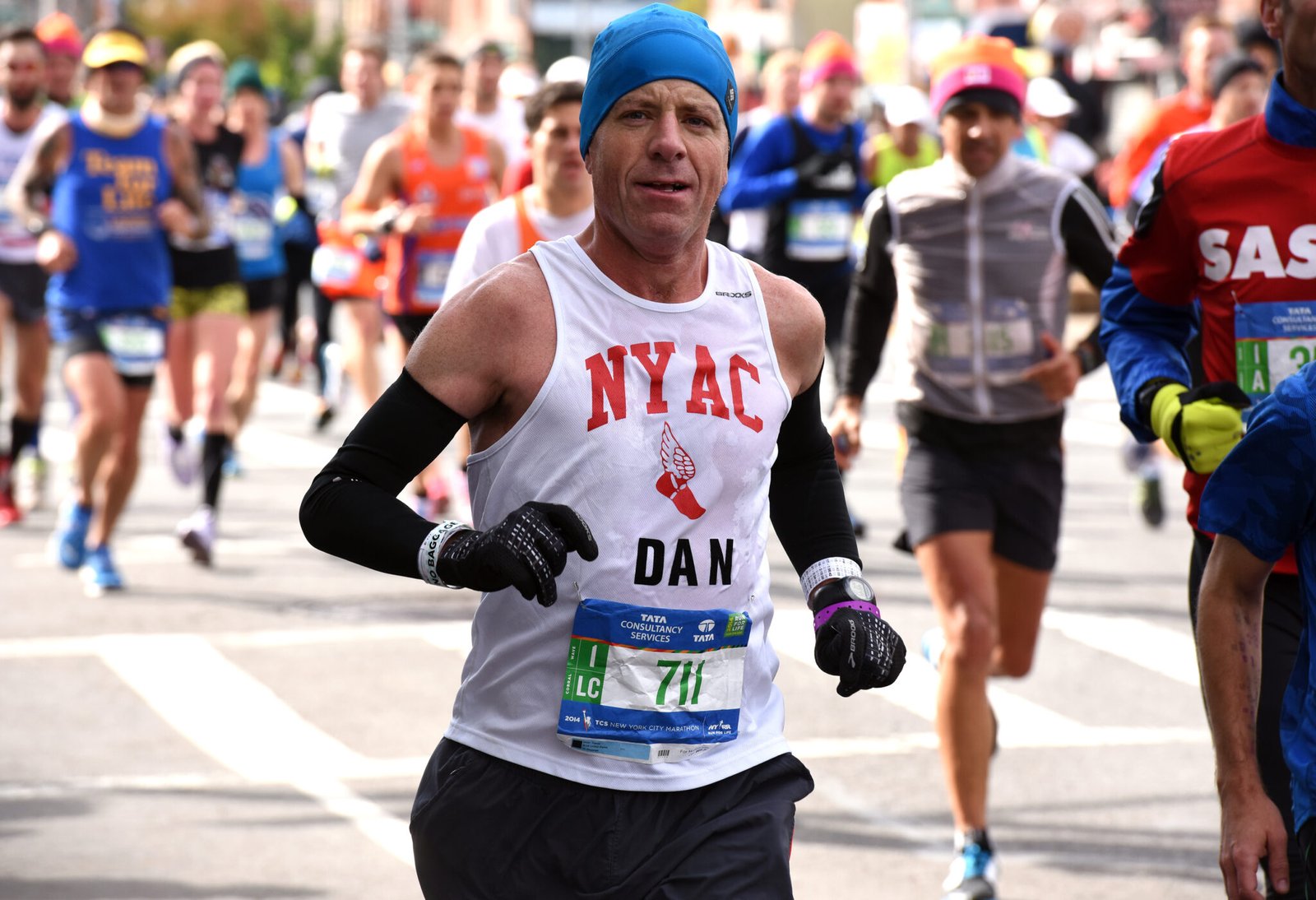
Feature Photo by Steven Pisano from Brooklyn, NY, USA - 2014 New York City Marathon, CC BY 2.0
For some people, the NYC Marathon is a once in a lifetime experience. For others, it’s part of a routine that takes place year after year.
New York Road Runners maintains a list of runners who have completed 15 or more New York City Marathons. Besides earning those finishers bragging rights, completing 15 marathons also grants a runner guaranteed entry into future races.
Alongside the 9+1 program and time qualifiers, this is a third major category of guaranteed entry. It’s smaller than the others, but it’s getting bigger. In 2011, NYRR briefly considered eliminating the category altogether. It was supposed to be eliminated after 2015, but they reinstated it in 2016.
I recently published an analysis of NYC Marathon results to shed some light on how many runners entered the marathon through 9+1 and through time qualification. Today, I want to focus on this list of streakers and 15 time finishers.
It’s an interesting dataset, and I plan to dig into some other questions – like how an individual runner changes over the course of their life – later. But for today, we’ll just focus on some topline stats and a breakdown of who these runners are.
Topline Stats on Streakers and 15 Time Finishers
Let’s start with a few topline stats about this group. This list and the results for each runner were collected in late November following the 2025 New York City Marathon.
A total of 1,813 have currently completed 15 or more New York City Marathons. About 80% of them (1,461) are men and the other 20% are women. This disparity is no doubt a reflection of the fact that the New York City Marathon (like other marathons) was still overwhelmingly male through the 1970’s and 1980’s.
Of these 1,813 finishers, about two thirds of them have never had an active streak of 15 or more years in a row. They’ve run a total of 15 or more marathons, but they took a year off at some point. 425 runners had a streak at one point, but that streak is no longer active.
And 284 runners have a current, active streak of 15 or more years. The gender split for this group is 75-25. On the one hand, it’s a sign that things have gotten (somewhat) more equal. But I’m also curious if there’s evidence that women are less likely to maintain a long streak (due to child rearing, uneven parenting responsibilities, or other reasons). But that’s a question for another day.
There were 614 finishers at this year’s New York City Marathon who had completed 15 or more marathons prior to this year. In other words, over 600 finishers earned entry through their legacy status.
When Did These Runners Start Running?
To get a better understanding of who these runners are, let’s start by visualizing when they first ran the New York City Marathon. The visual below shows the number of legacy runners who ran their first marathon in each year, broken out by gender.
From 1970 to 1975, there are only a handful of people. In the early 1970’s, it was still a very small race – until the first five borough race in 1976. From the late 1970’s on, there were typically 40 to 60 legacy runners who ran their first race in each year.
The peak year was 1979. There are a couple of other peaks along the way. I wonder if ’85 was a big year because it’s a round number – or because it was the year after the Olympics. 1984 was also the first women’s Olympic marathon, and 1985 had a particularly large number of women who began their legacy status journey.
2001 is another peak year of historical note. The marathon took place in the aftermath of the 9/11 attacks, and the field was smaller than usual. But for the people who did run the race, it may have held a special significance – and been the start of a new routine.
Over time, there’s also a trend towards more women. In the early years, just like the marathon, it was overwhelmingly male. The share of women increased through the 1990’s and early 2000’s, and it peaked at the end of the time period (2007-09).
How Old Were They When They Started?
The list of legacy runners included their age when they ran their latest race and the year of that race. I used that to calculate their birth year, and from that I was able to calculate their age in any given year.
In the visual below, I identified the first race that a runner ran – and calculated their age at that race. That data is visualized below.
Note that there are a handful of clear outliers resulting from bad data. In a handful of cases, it looks like a younger runner was matched by NYRR with an older runner’s profile. I eliminated the most obvious of these cases, but it’s possible there are a few of these in the dataset.
The resulting distribution is normal-ish. There’s a peak in the middle – highest in the late 20’s to late 30’s. But there’s a steep drop off on the left, with very few runners starting in their teens or early 20’s. It’s not until age 23 that there’s a sizeable cohort of runners.
On the flip side, things start to drop off in the 40’s. Relatively few of these runners ran their first race in their 40’s, and those numbers drop even further in their 50’s. Partially it’s a matter of logistics – if you run your first race at 50, it may be hard to get 15 races in before old age forces you into retirement. But I suspect it’s also evidence that most runners start out earlier in life – and most runners who are still running at 60-70 have been doing so for a long time.
On the far left end, there are a handful of outliers who started in their teens. For example, Stanley Zaslau just completed the 2025 NYC Marathon at age 59. He ran his first NYC Marathon in 1982 – at the age of 16. Since then, he’s completed a total of 28 races.
On the flip side, there are a handful of runners who did start out much later in life. For example, Ginette Bedard ran her first NYC Marathon in 2002 – at the age of 69. She maintained a streak for the next 17 years, running every marathon until 2019 (age 86).
How Old Were They When They Stopped?
It’s impossible to know for sure if and when a runner has “retired” from the New York City Marathon. They’re included in the list even if – like Ginette Bedard – they haven’t run the race in five or six years. For others, it’s possible that they take a year or two off and return in a future race.
But to get an idea of what age people stop running at, I identified everyone in the dataset who didn’t run the 2025 New York City Marathon. Then, I identified their age in the last race that they ran and visualized it below.
The highest point in the graph is from a runner’s late 50’s through their late 60’s. The last really tall peak is at age 70. Although some continue on into their 70’s and 80’s, there are way more people who take a break at 70 than at 71-75. And more at 75 than from 76-80. There’s likely a tendency for people to pick a year with a nice round number to call it quits and officially retire – assuming injuries and life don’t force the issue first.
How Many New Legacy Runners Are There Each Year?
Finally, here’s a question that’s more relevant for understanding entry into the marathon. How many runners finish their 15th race each year – and how quickly is this group growing?
For this visual, I identified the year in which each runner ran their 15th New York City Marathon. Some may have run many more after that, but that’s not relevant for this question.
The number of new legacy runners increased through the late 90’s. It leveled off somewhere around 2007 to 2011. From that point through 2024, the number remained around 60 new runners per year.
This year, there was a big spike. Over 100 new runners finished their 15th New York City Marathon this year. If this is a one time spike, it’s not a big deal. But if this is a new trend – and there continue to be 100+ new legacy finishers each year – it may just be a matter of time before this group’s entry into the New York City Marathon gets revisited.
The Bottom Line on NYC Marathon Legacy Finishers
Currently, there are about 1,800 runners who have finished 15 or more New York City Marathons. They are guaranteed entry into the marathon each year, and that group continues to grow each year. This year saw the largest increase in the history of the race – with over 100 new legacy finishers.
This group tilts heavily male, but it is becoming more balanced. Most of these runners started out in their 20’s and 30’s, and they typically retire in their 50’s or 60’s. But some keep going. Thomas Hart ran this year’s race at age 79. He ran the 1971 New York City Marathon at age 25. Of this year’s finishers, he and one other man (Dave Obelkevich) are the only two who ran the original Central Park course from 1970-1975.
Fun fact: the man in the feature photo at the top of this post (Dan) ran his 15th New York City Marathon in 2025. I was looking for an image on Wikimedia Commons, came across this one, and thought it made a good cover photo. I decided to check the results – and it was just a coincidence that he hit 15 marathons this year.
I’ll come back to this dataset to analyze some more interesting questions another time. But for today, I just wanted to do a quick overview of who’s in the dataset – and see how quickly this group was growing.
If there are any particular questions you’re interested in, leave a comment below and I’ll keep them in mind when I do the follow up analysis.
You pinpoint that this year had the most people finishing their 15th. Its definitely a new trend starting because theres tons of people I know and spoken at the expo who’s trying to reach the 15 club and are very close. Alot of these particular runners simply qualify and just walk the marathon every year and dont care about racing it which allows them to just do it every year without that feeling of burnt out and without getting injured. Especially alot of the legacy runners trying to maintain their streak are simply walking the marathon now to keep their streak active. NYRR needs to revisit this category and make it harder say “20+ finishes” because, 15 ain’t good enough nowadays.
I found this article and it is very interesting. I am a member of the 15 +. I have completed the NYC Marathon 35+ times. I fit into your dataset. Started in 1985 in my mid 20’s even though I was entered the previous 3 years. Drop out one year because I didn’t like my projected finish time. I had a few injuries that stopped me from running.
I look forward to this race every year, I appreciate NYRR for having this category otherwise I would do the 9 +1 each year. I look forward to more of your studies. Keep up the good work