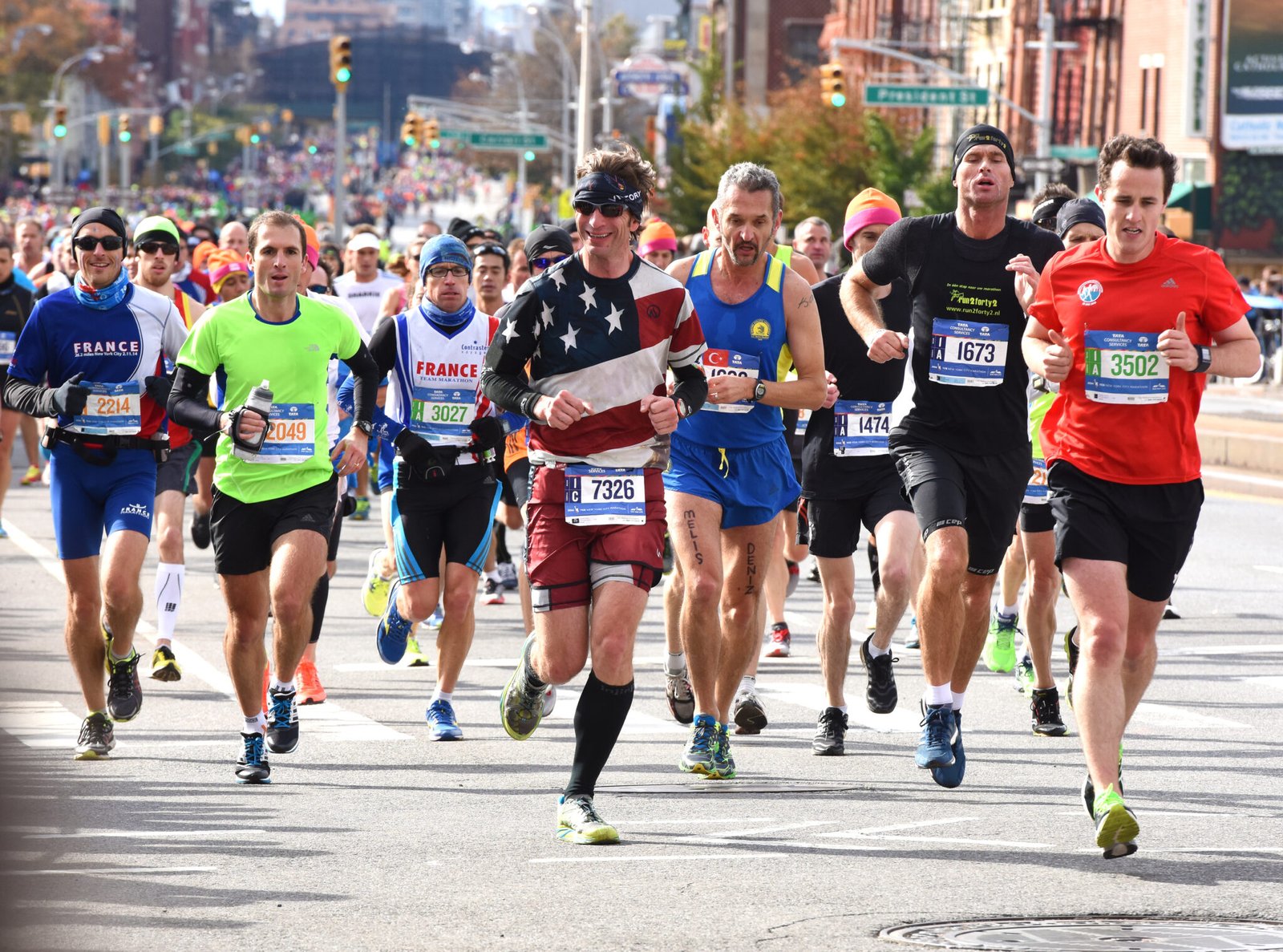
Feature photo by Steven Pisano on Flickr – CC BY 2.0
When I did a deep dive on the data from the 2025 New York City Marathon, I included a breakdown of where runners were from across the world and across the country. Just over 30% of runners are international. Of American runners, the biggest groups came from New York (~23k) and New Jersey (~4k).
At the time, I didn’t dig any deeper than that. When I was exploring the data from Philly, though, the results included runners’ zip codes. This made it much easier to map things on a more granular level, and that analysis included a brief look at how runners were distributed across Pennsylvania, New Jersey, and New York.
The visuals were striking – clusters of runners in and around urban centers and big empty expanses. On the one hand, this could hint at the types of people who become runners and who run in big city marathons. On the other, it could just be a function of population density in those areas.
That got me thinking that it would be interesting to do something similar with the New York City Marathon. It’s the biggest race in the area, and there’s a sizeable group of runners spread across both New York and New Jersey. The problem is that the results only included a runner’s city – not their zip code – so a little data cleanup was required. But once that was done, it was easy enough to visualize things.
So today we’ll take a quick look at where those 27,000 runners are from – how they’re spread across the state and whether there are any interesting patterns.
Cleaning Up the Data
First, a quick word about cleaning up the data and getting it into a presentable format.
To visualize data on a map, you need to connect each data point to a geographic area. In some cases this is really simple. Things like zip codes and census tracts are well defined, and if your data is connected to either of those – life is good.
Our data is not. It includes a state and a city name. And that city name is not standardized in a very rigid way.
First, there’s the question of what exactly a city is.
New Jersey has over 500 municipalities with defined boundaries, but within those are other locations that have a distinguishing name – but are technically part of the municipality. For example, Woodbridge Township includes both Avenel and Fords. People identify as being from these places, but technically they are part of Woodbridge.
Similarly, New York is divided into cities and towns. It also has many villages, and these smaller governing units are typically within a town. Then, you’ve got New York City – divided into five distinct boroughs but technically still one city. And you’ve got a similar bunch of unofficial neighborhoods and areas that have names – but are within one of these other governing bodies.
In the case of New Jersey, I cleaned up the data and consolidated every record into one of the municipalities. For New York, I cleaned things up by consolidating every record into a town or a city. I would have preferred to divide the five boroughs into distinct units, but the source data has a lot of ambiguity. Over 10,000 runners just put “New York,” and I don’t think it’s a safe assumption that they all meant Manhattan.
New Jersey has one other fun quirk. You’d typically expect the names of municipalities within a state to be unique. But not New Jersey. For example, there are five Washington Townships, all with the exact same name, scattered across the state in different counties. There are about a dozen such names, and without an additional piece of information (county or zip code), it’s impossible to distinguish which one a runner meant. So I assigned them all to the largest municipality with that name.
There were also a few clear examples of typos and errors. I don’t think there’s a Chicago, Dallas, or Hollywood in New York State – so a handful of records where a runner listed their state as New York or New Jersey were excluded.
Where In New York Are Runners From?
Now that we’ve gone over the boring methodology stuff, let’s get to the map.
The visual below shows the map of the ~23,000 finishers from the 2025 New York City Marathon who live in New York. The shade of blue indicates how many finishers live in that city or town. If at least one finisher is from a town, it’ll be light blue. An area that’s white or gray had no finishers at all. You can use the search icon to look for a specific town or city.
Unsurprisingly, the darkest shade of blue is in the city itself. The race is based in the city, so you’d expect a lot of runners to come from there. And the city itself makes up close to half the population of the state.
There are also quite a few runners from Long Island and from the suburbs north of the city. But when you get upstate, there are vast expanses of blank territory. There are a couple of clusters around the larger cities – Albany, Syracuse, Rochester, Buffalo – but otherwise there’s a lot of nothingness.
In that vast expanse, there are a few scattered dots here and there. But relatively few runners come from a) upstate New York and b) not in the metro areas.
And looking at the map, some of these may be inconsistencies in the data. There’s a blue area at the northern tip of the state – Lawrence, a town in St. Lawrence county. But it’s possible that some (all?) of those runners are from Lawrence – a village in Hempstead on Long Island. Similarly, there are five runners from Baldwin – which is currently mapped to a small town upstate but is probably more likely to be a community within Hempstead.
Today I learned that New York is just as bizarre as New Jersey …
Given just how big New York City is compared to the rest of the state, it can be tough to make sense of things. So another way to look at this is to standardize the data according to the population of a given city or town.
The visual above includes the same data as the previous map – but the number and the shade of blue indicate the number of runners per 1,000 residents (according to the 2020 census) in that town or city.
New York City is home to more runners – as a proportion of population – than most of the state. At 2.16 per 1,000 people, that’s one of the highest in the state. Two places with a higher rate (Baldwin and Lawrence) are tiny towns that are probably mislabeled.
But all of the legitimate places that have a higher rate of runners are in the suburbs just north of the city – Scarsdale (5.75), Pelham (2.37), Mamaroneck (2.24), and Eastchester (2.08). Many of the surrounding suburbs have a rate above 1.
On a normalized basis, Long Island supplies fewer runners. North Hempstead (0.97) and Huntington (0.93) have the highest rates, with some of the places under 0.50.
Outside the city, most of those other clusters also have very low rates. For the most part, they’re a tiny fraction of a runner per 1,000 residents – far lower than New York City and the surrounding area.
So in terms of New Yorkers, the race is heavily populated by city residents and the surrounding suburbs. There are relatively few runners from upstate, and those who do participate tend to be in the other urban centers throughout the state.
Where In New Jersey Are Runners From?
About 4,000 runners cross the river from New Jersey to participate. The map below is set up like the first one above – showing the absolute number of finishers from each municipality.
The darkest blue is in the northeast part of the state – Jersey City. It’s also directly across from New York City and connected to downtown by the PATH train.
There are quite a few runners scattered throughout the northern suburbs – Essex, Union, and Bergen. Out in the western part of the state (Hunterdon, Warren counties) there’s a lot of blank territory.
Central Jersey also has a few hotspots – Middlesex County, Monmouth County. But down in south Jersey there are very few runners. Even that string of blue across the southern part of the state is mostly 1 or 2 runners per town.
And here’s a normalized version of the map, showing the number of runners per 1,000 residents.
While Jersey City is still a hotspot, it has 1.84 finishers per resident (lower than New York City). And the densest area is right next to it – Hoboken. At over 5 per 1,000 that’s a lot of people.
If you look out in the suburbs, there’s an interesting pattern.
Take Essex County, for example. The densest areas are Glen Ridge, Montclair, Millburn, Livingston, and South Orange – some of the wealthiest suburbs in the county. West Orange, Verona, Cedar Grove, and Bloomfield – which are significantly less wealthy than the others – have lower rates. And the eastern part of the county – Newark, Orange, East Orange, and Irvington – have hardly any runners. These also happen to be urban areas with much lower median incomes.
Some of the other denser areas – Westfield, Cranford, Bernards, Madison, Chatham – are also on the wealthy side. Meanwhile, two of the largest suburbs in the state – Edison and Woodbridge – each have less than 0.5 runners per 1,000. While they each have some wealthy residents, they’d be classified as middle class as a whole. And down by the shore, one of the wealthiest towns in the state – Rumson – also has one of the highest rates (2.59).
On the west side of the Hudson, runners are also clustered in the cities and suburbs closest to New York City. But there’s also some evidence that wealthier towns have higher concentrations of finishers than other towns.
So What’d We Learn About New York City Marathon Finishers?
In general, I’d draw two conclusions from this data.
The first, and the clearest one, is that runners who live near New York City are more likely to participate in the New York City Marathon. There are relatively few runners from upstate New York or from the western and southern parts of New Jersey.
Besides the obvious reason – proximity – this is likely related to two other things. One way to get into the New York City Marathon is to do 9+1 and run 9 NYRR races. This is obviously going to be easier for people within a reasonable driving distance of the city. Another way is to get in through the lottery, and there’s a sub-group in the lottery for people who live within 60 miles of New York City.
If you drew a circle with a radius of 60 miles around the city – you’d get those New Jersey suburbs, those New York suburbs, and much of Long Island. The furthest town in New Jersey that’s relatively dense is Princeton – and it’s just about 60 miles from New York City. People who live further away may just have a tougher time getting into the race.
The second, and this could use some more investigation later, is that participants tend to come from wealthier areas. I don’t know enough about the New York suburbs to say anything about them with confidence. But looking over the map of New Jersey, this seems pretty obvious to me.
Big city marathons aren’t cheap, and the Majors like New York City are more expensive than most. Throw in the cost of 9+1 (if that’s how runners get in), and you’re looking at a pretty expensive hobby. I bet if you did an analysis of Six Star and Seven Star Finishers, you’d find a similar pattern.
For now, we’ll file that under, “Things that make you go, hmm.” And make a note to investigate another day.
Did you notice anything interesting in this data? Or do you have any follow up questions?