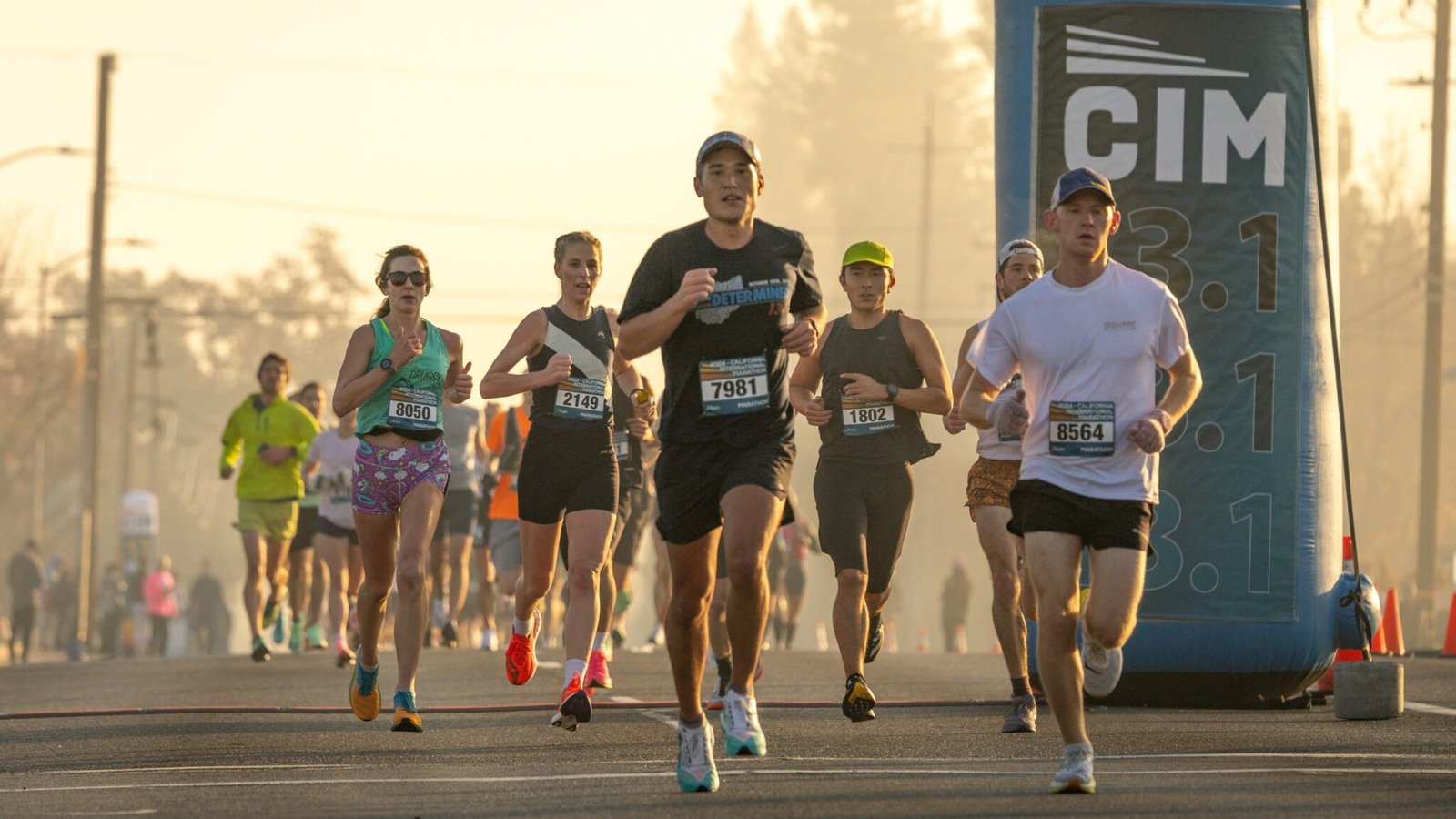
Last weekend was the California International Marathon – along with the USATF Marathon Championship. It was a day for records and blazing fast times – although one record that wasn’t set was for field size.
CIM is typically among the largest races in the United States. But after peaking above 9,000 finishers in 2023, this is the second year in a row that it’s been lower than that.
With it’s net downhill course, it’s super popular among people who are trying to run fast. The net drop is low enough that the course is still eligible for use as an Olympic qualifier, so it attracts everyone from the sub-elites trying to crack that OTQ To someone trying to hit their BQ.
Today we’re going to dive into the data from CIM 2025. A few questions we’ll answer along the way:
- Are the demographics of the field changing?
- Where are the runners from?
- How many runners went sub-3:00 – and how does this compare to other races?
- How many runners BQ’d – and what does this mean for the cutoff?
- How many runners OTQ’d – and how does this compare to previous years?
- Who ran new record times?
Let’s get to it.
Has the Field at the Race Changed?
Unlike many of the other races that I’ve looked at this year, the field size at CIM is not increasing. Two years ago, there were about 9,200 finishers – a record for the race. In 2018 and 2019, the field size was in the high 7,000’s – and for years it had hovered around 6,000.
Since then, the field has seen some retrenchment. Last year’s race had about 8,400 finishers and this year’s race had about 8,200. When last year’s race was so much smaller than 2023, I thought maybe it was a one year dip and it would rebound this year. But it’s held steady for two years in a row, which suggests that this may be the long term target field size.
Typically, the race has about a 60-40 breakdown of men to women. Since 2023, the number of both men and women is down – but the decrease has been proportionally larger among women. This year, only 37.2% of the field were women – down a couple percentage points from 2023.
If you look back over the past ten years, the number of women has stayed about the same. Since 2016, the total number of finishers has increased about 2,000 – and it’s almost entirely on the men’s side.
When you look at the age groups, that increase is also concentrated among younger runners under 40. Back in 2016, the majority of men were over 40. Now, about 60% are under 40. Although the trend started before COVID, it was supercharged in 2023.
One other aspect of the field to consider is where the runners are from. Although the name of the race is the California International Marathon, there are relatively few international runners. This year, about 6% of the field was from another country, primarily Mexico or Canada. To be fair, that is higher than some other big races like Philly, but it’s far less than truly international races like the Majors.
Of the runners from the United States, the vast majority of them are from California. About 70% of the American finishers are from California. The next most common states – with 2-3% each – are Colorado, Washington, Texas, New York, and Oregon. The exact order varies year to year, but this is typical of the last few years.
How Many Runners Went Sub-3:00?
I recently published an analysis of how many runners complete a marathon in under three hours. This can vary quite a bit from race to race for a number of reasons, including the course profile and the weather. But it can also vary because of a selection effect whereby fast runners choose a particular race.
This is one reason why Valencia has such a high rate of sub-3:00 finishers. It’s a flat, fast race with good weather – but that alone doesn’t explain why 30% of young men break three hours.
CIM is one of those races. The net drop in the course certainly plays a role. But it’s also a race that attracts fast runners.
Of American races, it has among the highest rates of sub-3:00 finishes of any race. The visual below compares CIM to five other fast American races (Boston and Chicago for Majors; Indy, Houston, and Grandma’s for non-Majors).
It shows the percent of runners under 45, broken out by gender, who finish under three hours. I looked at the last three years, and the data displayed is from the best of those three years. Hover over a bar to see which year that particular race’s data comes from.
On the men’s side, the 28.6% at CIM is close to the ~30% that is typical of Valencia. The only major American race with a higher rate of sub-3:00 finishes among men is Boston. And that’s a special case, because the vast majority of those runners needed to break three hours just to qualify to run Boston. Indy comes in not too far behind CIM – a testament to just how fast that field is.
But the women’s side is what caught my attention. While I was working on an analysis of the Valencia results, I noticed that the share of women finishing sub-3:00 was high. I started looking for other races to compare it to, expecting in part that the outcome would be similar as the men’s side of things. But it wasn’t.
In 2023, 11% of the women under 45 at CIM finished in under 3:00. This wasn’t an outlier, either, although it is a newer phenomenon. Most years going back to 2018, the rate is around 10-11%. That’s higher than Valencia (~6%), and Boston and Indy come next with around 5%.
The visual above looks at the actual number of women (inclusive of all ages) who broke three hours. Here, the larger races have an advantage – and Chicago, Boston, Berlin, and Valencia come out ahead. But CIM isn’t far behind with 290 women in 2023 – and it finishes ahead of London, a race with 5x as many finishers.
How Many Runners Qualified for Boston?
CIM is a big race with a lot of fast finishers. And that means that it’s an important part of the equation for understanding the potential Boston cutoff time. It’s often the fifth most common qualifying race – behind only bigger races like Boston, Chicago, London, Berlin and New York.
Last year, the number of finishers dropped. The qualification rate was also much lower, which was to be expected because of the new qualifying times. So what happened this year?
The qualification rate was, for most age groups, slightly higher this year than last year. So despite a net drop in finishers, the number of BQs was higher.
Across just about every age group, there were more BQ’s this year than last year – with a slight dip among women under 30 and women over 60 being the only exceptions. In total, the number of BQs increased from 2,167 to 2,308.
Just another sign that the trajectory of the Boston cutoff time is heading up – and this year’s cutoff time will most likely be higher than last years. You can read a more in depth update on the state of the qualifying field and the potential cutoff time here.
How Many Runners Qualified for the Olympic Trials?
The qualifying period for the 2028 Olympic Trials Marathon began on September 1. Before CIM, there had been a few dozen runners who had already OTQ’d – spread across a bunch of fast races like Chicago, Berlin, and Indy.
But CIM is the chief qualifying race, and there are consistently more qualifying times at CIM than any other race. I saw somebody post a question on Reddit this week, asking if the number of OTQ’s so far was higher than usual. So I looked back through the historical data to see.
The graph above shows the number of OTQ’s at CIM each year going back to 2017. There was no race in 2020, and the qualifying period for the 2024 Trials didn’t start until January 1, 2022 – so CIM 2021 wasn’t a potential qualifier. Note that due to inconsistencies in the historical data about a runner’s country, these numbers might be off by one or two – but they’re still a good indication of how many runners beat the qualifying standard in any given year.
The highest year – for both men and women – was 2018. This was in the qualifying period for 2020, when the standard for men was 2:19 and the standard for women was 2:45. Close to 100 women qualified that year along with over 50 men. The other two years in that period (2017 / 2018) also had a higher number of qualifiers, but not quite as high.
Going into the next qualifying period (2022 / 2023), the standards for each group were tightened. Men now needed a 2:18 and women needed a 2:37. The number of women dropped precipitously – but the number of men was only slightly lower.
This year, the standards were tightened for men (2:16) but not for women (still 2:37). This caused some hand-wringing, with some people complaining that 2:16 was too tough and that it would eliminate a lot of men from running in the Trials. And while it has eliminated some folks – it didn’t stop this year from being the biggest qualifying year at CIM since 2018.
This year, 52 men met the new standard – the same exact number who hit the old standard back in 2018. the number of women was also above 50, which it had not been in the last qualifying period.
To help put in perspective how much goal setting can influence things, I took the same data and recounted the number of qualifiers – using the current standards for each year.
Back in 2017-19, when the women’s standard was 2:45, relatively few women hit 2:37. But once that standard was dropped in 2022, the number of women under 2:37 increased significantly.
Likewise, the number of men running under 2:16 was much lower when the standard was 2:18/2:19. This is the first year that more than 20 men ran under 2:16.
If you tighten the standards, some people will be eliminated. But many others will pick a new target, train appropriately, and reach their goal.
I’ve put together a dashboard to track the number of USOTQ’s throughout the qualifying period here. It also tracks the number of men who ran between 2:16 and 2:18 and were effectively eliminated by the new standard.
Who Ran a Record Breaking Performance?
Finally, let’s wrap things up by reviewing some record breaking performances.
You’ve probably already heard that the women’s winner, Molly Born, set a new course record (2:24:09) in her debut performance. The second place finisher, Sara Hall, also set a new masters course record (2:24:36).
On the men’s side, Fustum Zienasellassie set a new American course record (2:09:29). The two runners up were right behind him, and they also beat the previous American course record – set last year by CJ Albertson.
But one record that I didn’t see reported elsewhere: Esteban Trujillo. He’s 40 years old, and he finished in 2:14:30. The previous Masters course record for men was 2:15:35 (Pierre Levisse of France, 1992).
If you wade through the individual age groups, there was also a new record set by Jacob Nur for men 70-74. He finished in 2:59:01. The previous best for that age group was 3:05 (John Keston, 1996).
And finally, two honorable mentions for age group awards.
Alison Blackmore, in the womens 60-64 age group, finished in 3:09:09. That’s only 14 seconds off from the age group record (Eri Chalat, 3:08:55, 2021).
And finally, there’s the men’s 80+ age group. This time, it was the name that caught my eye: Andrew Suozzo. I’m going to assume this is the same Andrew Suozzo who wrote the history of the Chicago Marathon. He finished in 4:22:51, which is third on the all time list at CIM for that age group.
The Bottom Line on CIM 2025
The California International Marathon is a race where runners go to run fast – and CIM 2025 did not disappoint.
A shockingly high percentage of runners broke three hours, many qualified for Boston, and an almost unprecedented number qualified for the next Olympic Trials. The winners set new records, as did some of the masters and age group finishers.
But perhaps the most stunning takeaway for me was the percent of women who go sub-3:00 at CIM: over 10%. If you’re looking for a concentration of women’s running talent, you’re not going to find anything like it. A few of the big races have more overall numbers – but none of them have even close to that proportional size.
Did you run the 2025 California International Marathon? Or have you run CIM before? Let me know how it went – or if you have any other questions about the data.
Has the CIM organization limited the number of runners? It seems to sell out in a couple days every year. I ran in 2023 and registered in the first couple hours to get in.
Last year, the race sold out in May, and according to SRA that was the earliest it’s ever sold out. So it doesn’t sell out in days (like Grandma), but it is definitely a consistent sell out.
It does seem like they’ve capped the number of runners at around 8,000 to 8,500. Two years ago, there were ~9,200 finishers. But since then, there were 8,400 last year and 8,200 this year. It’s not for lack of demand, so the only logical explanation is that they’ve set a cap on registration.
The actual registrant cap is probably higher (9,000 to 9,500), and then a certain amount of people no show or defer for a variety of reasons.